Newton (N)
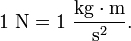
The newton is the unit of force derived in the SI system; it is equal to the amount of force required to give a mass of one kilogram an acceleration of one metre per second squared. Algebraically:
The newton is the unit of force derived in the SI system; it is equal to the amount of force required to give a mass of one kilogram an acceleration of one metre per second squared. Algebraically:

Because cluster bombs release many small unexploded bomblets over a wide area, they can kill or maim civilians long after a conflict has ended. Unexploded submunitions are very costly to locate and remove.
Cluster bombs are prohibited under the Convention on Cluster Munitions, which was adopted in Dublin in May 2008 and will open for signature in December 2008. The general rules of international humanitarian law aimed at protecting civilians also apply to cluster bombs as they do to all weapons.
DevelopmentThe first cluster bomb used operationally was the German SD-2 or Sprengbombe Dickwandig 2 kg, commonly referred to as the Butterfly Bomb. It was used during the Second World War to attack both civilian and military targets. The technology was developed independently by the United States of America, Russia and Italy. Cluster bombs are now standard air-dropped munitions for many nations, in a wide variety of types. Currently produced by 34 countries and used by at least 23.
Artillery shells that employ similar principles have existed for decades. They are typically referred to as ICM (Improved Conventional Munitions) shells. The US military slang terms for them are "firecracker" or "popcorn" shells, for the many small explosions they cause in the target area.
Types of cluster bombsA basic cluster bomb is a hollow shell containing from three to more than 2,000 submunitions. Some types are dispensers that are designed to be retained by the aircraft after releasing their munitions. The submunitions themselves may be fitted with small parachute retarders or streamers to slow their descent (allowing the aircraft to escape the blast area in low-altitude attacks).
A growing trend in the design of submunition-based weapons is the smart submunition, which uses guidance circuitry to locate and attack particular targets, usually armored vehicles. Recent weapons of this type include the U.S. CBU-97 sensor-fused weapon, first used in combat during the 2003 invasion of Iraq. Munitions specifically intended for anti-tank use may be set to self-destruct if they reach the ground without locating a target, theoretically reducing the risk of unintended civilian deaths and injuries. Although smart submunition weapons are many times more expensive than standard cluster bombs, which are cheaper and simpler to manufacture, far fewer smart submunitions are required for defeating dispersed and mobile targets in an area, offsetting this cost.
IncendiaryIncendiary cluster bombs are intended to start fires, just as conventional incendiary bombs (also called firebombs). They are specifically designed for this purpose, with submunitions of white phosphorus or napalm, and they often include anti-personnel and anti-tank submunitions to hamper firefighting efforts. When used in cities they have often been preceded by the use of conventional explosive bombs to break open the roofs and walls of buildings to expose flammable contents to the incendiaries. One of the earliest examples is the so-called Molotov bread basket first used by the Soviet Union in the Winter War of 1939-40. This type of munition was extensively used by both sides in the strategic bombings of World War II. Bombs of this type were used to start firestorms in cases such as the bombing of Dresden in World War II and the firebombing of Tokyo. A modern development of the incendiary cluster bomb is the thermobaric weapon. In these types of weapons, submunitions are used to deliver a highly combustible aerosol, which is subsequently ignited, resulting in a high pressure explosion.
Anti-personnelAnti-personnel cluster bombs use explosive fragmentation to kill troops and destroy soft (unarmored) targets. Along with incendiary cluster bombs, these were among the first forms of cluster bombs produced by Germany during World War II. They were famously used during the Blitz with delay and booby-trap fusing to prevent firefighting and other damage control efforts in the bombed areas. They were also used with a contact fuse when attacking entrenchments. These weapons were most widely used during the Vietnam War when many thousands of tons of submunitions were dropped on Laos, Cambodia and Vietnam.
The CBU-24 (Cluster Bomb Unit-24) is a weapon developed by the United States for anti personnel purposes.The weapon contains 665 BLU-26 tennis ball-sized submunitions, each designed to detonate with 600 metal fragments for an anti-personnel / anti-materiel effect.

Most anti-armor munitions contain shaped charge warheads to pierce the armor of tanks and armored fighting vehicles. In some cases, guidance is used to increase the likelihood of successfully hitting a vehicle. Modern guided submunitions, such as those found in the U.S. CBU-97 can use either a shaped charge warhead or an explosively formed penetrator. Unguided shaped-charge submunitions are designed to be effective against entrenchments that incorporate overhead cover. To simplify supply and increase battlefield effectiveness by allowing a single type of round to be used against nearly any target, submunitions that incorporate both fragmentation and shaped-charge effects are produced. In United States Army and Marine Corps Field Artillery units, this is a common type of shell used in ground warfare.
Anti-runwayAnti-runway submunitions such as the British JP233 are designed to penetrate concrete before detonating, allowing them to shatter and crater runway surfaces. In the case of the JP233, the cratering effect is achieved through the use of a two-stage warhead that combines a shaped charge and conventional explosive. The shaped charge creates a small crater inside which the conventional explosive detonates to enlarge it. Anti-runway submunitions are usually used along with anti-personnel submunitions equipped with delay or booby-trap fuses that act as anti-personnel mines to make repair more difficult.
Mine-layingWhen submunition-based weapons are used to disperse mines, their submunitions do not detonate immediately, but behave like conventional land mines that detonate later. The submunitions usually include a combination of anti-personnel and anti-tank mines. Since such mines usually lie on exposed surfaces, the anti-personnel forms, such as the US Area Denial Artillery Munition normally deploy tripwires automatically after landing to make clearing the minefield more difficult. In order to avoid rendering large portions of the battlefield permanently impassable, and to minimize the amount of mine-clearing needed after a conflict, scatterable mines used by the United States are designed to self-destruct after a period of time from 4-48 hours. The internationally agreed definition of cluster munitions being negotiated in the Oslo Process may not include this type of weapon, since landmines are already covered in other specific international instruments.
Chemical weaponsDuring the 1950s and 1960s, the United States and Soviet Union developed cluster weapons designed to deliver chemical weapons. The Chemical Weapons Convention of 1993 banned their use. Six nations declared themselves in possession of chemical weapons. The US and Russia are in the process of destroying their stockpiles, although they have received extensions for the full destruction.
Anti-electricalAn anti-electrical weapon, the CBU-94/B, was first used by the U.S. in the Kosovo War in 1999. These consist of a TMD (Tactical Munitions Dispenser) filled with 202 BLU-114/B submunitions. Each submunition contains a small explosive charge that disperses 147 reels of fine conductive fiber, either carbon fiber or aluminum-coated glass fiber. Their purpose is to disrupt and damage electric power transmission systems by producing short circuits in high-voltage power lines and electrical substations. On the first attack, these knocked out 70% of the electrical power supply in Serbia. There are reports that it took 500 people 15 hours to get one transformer yard back on line after being hit with the conductive fibers.
Leaflet dispensing Specification
The Mark 84 has a nominal weight of 2,000 lb (908 kg), but its actual weight varies depending on its fin, fuze options, and retardation configuration, from 1,972 lb (896 kg) to 2,083 (947 kg). It is a streamlined steel casing filled with 945 lb (429 kg) of Tritonal high explosive.
The Mark 84 is capable of forming a crater 50 ft (15.2 m) wide and 36 ft (11 m) deep. It can penetrate up to 15 in (380 mm) of metal or 11 ft (3.3 m) of concrete, depending on the height from which it is dropped, and causes lethal fragmentation to a radius of 400 yards (366 m).
Many Mark 84s have been retrofitted with stabilizing and retarding devices to provide a precision guidance capabilities. They serve as the warhead of a variety of precision-guided munitions, including the GBU-10 and GBU-24 Paveway laser-guided bombs, GBU-15 electro-optical bomb, GBU-31 JDAM and Quickstrike sea mines.
The Mark 84 bomb is produced under license in Pakistan by the Air Weapon Complex.


 Specification
With a nominal weight of 500 lb (227 kg), it is the smallest of those bombs in current service, and one of the most common air-dropped weapons in the world. Although the Mk 82's nominal weight is 500 lb (227 kg), its actual weight varies considerably depending on its configuration, from 510 lb (232 kg) to 570 lb (259 kg). It is a streamlined steel casing containing 192 lb (87 kg) of Tritonal high explosive. The Mk 82 is offered with a variety of fin kits, fuses, and retarders for different purposes.
This photograph shows an unfused, museum display Mk. 82 with its usual combat paint scheme. For display purposes, the optional low-drag tailfins used for high-altitude release are shown.
The Mk 82 is the warhead for the GBU-12 laser-guided bombs and for the GBU-38 JDAM.
Currently the Mk 82 bomb body is manufactured by 17 plants worldwide. Currently only the General Dynamics plant in the Garland, Texas is DoD certified to manufacture bombs for the US Armed Forces.


 The General Electric J85 is a small single-shaft turbojet engine. Military versions produce up to 2,950 lbf (18 kN) of thrust dry, afterburning variants can reach up to 5,000 lbf (22 kN). The engine, depending upon additional equipment and specific model, weighs between 300 to 500 pounds (140 kg to 230 kg), giving it the highest thrust-to-weight ratio of any production turbojet in the world. It is one of GE's most successful and longest in service military jet engines, the civilian versions having logged over 16.5 million hours of operation. The United States Air Force plans to continue using the J85 in aircraft through 2040. Civilian models, known as the CJ610, are similar but supplied without an afterburner, while the CJ700 adds an uncommon rear-mounted fan for improved fuel economy.
General characteristics

Turbojets are quite inefficient (if flown below about Mach 2) and very noisy. Most modern aircraft use turbofans instead for economic reasons. Turbojets are still very common in medium range cruise missiles, due to their high speed, low frontal area and relative simplicity.
The Python is a family of short-range air-to-air missiles (AAMs) built by the Israeli weapons manufacturing company RAFAEL Armament Development Authority. The first was the Shafrir-1 missile developed in 1959, followed by the Shafrir-2 in early 1970s. Afterwards the missiles were given the western name of "Python", starting with Python-3 in 1978.


The Pontiac M39 was a 20 mm single-barreled revolver cannon developed for the United States Air Force in the late 1940s. It was used on a number of fighter aircraft from the early 1950s through the 1980s.
The M39 was developed by the Springfield Armory, based on the World War II–era design of the German Mauser MG 213, a 20 mm (and 30 mm) cannon developed for the Luftwaffe, but not used in combat. The same design inspired the British ADEN cannon and the French DEFA, but American designers chose a smaller 20 mm round to increase the weapon's rate of fire and muzzle velocity at the expense of hitting power.
Initially designated the T-160, the new gun was installed for combat testing on a number of F-86 Sabre aircraft under the "Gunval" program in late 1952, and used in action over Korea in early 1953. It was subsequently adopted as standard armament of the F-86H fighter-bomber, F-100 Supre Sabre, F-101A and F101C Voodoo, and the F-5 Freedom Fighter. Current models of the F-5 Tiger II still use the M39A2 version of this weapon.
missile which would home in on reflections from a target illuminated by the radar of the launching aircraft. It was effective at visual to beyond visual range. The early beam riding versions of the Sparrow missiles were integrated onto the F3H DemonThe AIM-7 Sparrow medium range missile (MRM) was developed by the US Navy in the 1950s as its first operational BVR air-to-air weapon. With an effective range of about 12 miles (19 km), it was introduced as a radar bean riding missile and then improved to a semi-active radar guided and F7U Cutlass, but the definitive AIM-7 Sparrow was the primary weapon for the all weather, gun-less F-4 Phantom II fighter/interceptor with up to four carried in special recesses under the fuselage.
Although designed for non maneuvering targets such as bombers, due to poor performance against fighters over North Vietnam, these missiles were progressively improved until they proved effective in dogfights. Together with the short range infrared guided AIM-9 Sidewinder, they replaced the AIM-4 Falcon IR and radar guided series for use in air combat by the USAF as well. A disadvantage to semi-active homing was that only one target could be illuminated by the launch aircraft at a time; also, the launch aircraft had to remain pointed in the direction of the target (within the azimuth of the aircraft radar, up to 60 degrees off the nose on some systems), which could be difficult or dangerous in combat.
The US Navy later developed the AIM-54 Phoenix long range missile (LRM) for the fleet air defense mission. It was an impressive 1000 lb (500 kg) Mach 5 missile designed to counter cruise missiles and their (Bomber) launch platforms. It was intended that eight of its first incarnation would be fitted to the straight-wing F6D Missileer, and then the F-111B. Neither aircraft was introduced into service and Grumman won the competition to replace the F-111B with a dogfighter with enough weight and volume for the Phoenix that became the F-14 Tomcat. Phoenix was the first US fire-and-forget multiple launch radar-guided missile: one which used its own active guidance system to guide itself without help from the launch aircraft when it closed on its target. This gave a Tomcat with a six Phoenix load the unprecedented capability of tracking and destroying up to six targets as far as 100 miles (160 km) away.
The Phoenix could only be carried by the huge 60000 lb (27200 kg) F-14, making the Tomcat the only US fighter with a multiple shot, fire-and-forget radar missile. A full load of six Phoenix weighed 6000 lb (2700 kg), and with the additional 2000 lb (900 kg) of dedicated launcher, it was so heavy it exceeded a typical Vietnam era bomb load; typically only two or four missiles were flown off the carrier as a full load was too heavy to be brought back on board for landing. Although highly lauded in the press, its operational service with the US Navy was primarily as a deterrent as its use was hampered by restrictive Rules of Engagement and the only reported combat successes were with Iranian Tomcats against Iraqi opponents. The US Navy retired its Phoenix capability in 2005 in light of availability of the AIM-120 AMRAAM on the F/A-18 Hornet.
Once the missile closes in on the target, its active radar guides it to intercept. This feature, mistakenly called "fire and forget," frees the aircrew from the need to further provide guidance, enabling the aircrew to aim and fire several missiles simultaneously at multiple targets and perform evasive maneuvers while the missiles guide themselves to the targets.
The missile also features the ability to "Home on Jamming," giving it the ability to switch over from active radar homing to passive homing - homing on jamming signals from the target aircraft. Software on board the missile allows it to detect if it is being jammed, and guide on its target using the proper guidance system. This, contrary to the attack sequence on a non-jamming target, truly can be described as "fire and forget", as it does not require any guidance provided to the missile after launch.


reduces the compoundIn the 1920s, it was discovered that exposing lead sulfide to infrared light (thermal radiation)'s electrical resistance. This is an example of a property called photoconductivity; photoconductivity is also seen with illumination by other wavelengths of light. One can measure the resulting current and then link that result to an action—in this case, a seeker head causing the missile to fly toward the heat source (a target aircraft or missile).
Prior to the war most of the major forces attempted to produce night-vision systems using lead sulfide detectors and image intensifiers as displays, mostly for long-distance aircraft detection. None of these proved very successful, and only the German "Spanner" system entered production. "Spanner" used a long sighting tube projecting through the aircraft windscreen to give the pilot a view of the air directly ahead of their aircraft, but had limited range. All of these projects ended with the introduction of useful airborne radar sets.
IR detectors found more widespread use for land-based systems. These included everything from sighting systems for tanks and even snipers, to a variety of night driving aids. However the Germans also experimented with an automatic missile guidance system intended to home in on the heat of aircraft engines and guide their Enzian missile. It used a single detector located at the focus of a small telescope, with four vanes positioned between the detector and telescope. The telescope "nodded", causing the signal falling on the detector to increase and decrease depending on how much of the signal was being blocked by the vanes. This signal would then be used as an input to a simple autopilot, by continually turning toward the telescope optical axis, the missile was guided toward the target using what is known as a pure pursuit. Development was not complete when the war ended.
Early developmentThe development of the Sidewinder missile began in 1946 at the Naval Ordnance Test Station (NOTS), Inyokern, California, now the Naval Air Weapons Station China Lake, California as an in-house research project conceived by William Burdette McLean. McLean initially called his effort "Local Fuze Project 602" using laboratory funding, volunteer help and fuze funding to develop what it called a heat-homing rocket. It did not receive official funding until 1951 when the effort was mature enough to show to Admiral "Deak" Parsons, the Deputy Chief of the Bureau of Ordnance (BUORD). It subsequently received designation as a program in 1952. The Sidewinder introduced several new technologies that made it simpler and much more reliable than its United States Air Force (USAF) counterpart, the AIM-4 Falcon that was under development in the same time period. After disappointing experiences with the Falcon in the Vietnam War, the Air Force replaced its Falcons with Sidewinders.
The Sidewinder took several design tips from the Enzian, but made a number of improvements that dramatically improved its performance. The first was to replace the "steering" mirror with a forward-facing mirror rotating around a shaft pointed out the front of the missile. The detector was mounted in front of the mirror. When the long axis of the mirror, the missile axis and the line of sight to the target all fell in the same plane, the reflected rays from the target reached the detector (provided the target was not very far off axis). Therefore, the angle of the mirror at the instant of detection estimated the direction of the target in the roll axis of the missile.
The yaw/pitch direction of the target depended on how far to the outer edge of the mirror the target was. If the target was further off axis, the rays reaching the detector would be reflected from the outer edge of the mirror. If the target was closer on axis, the rays would be reflected from closer to the centre of the mirror. Rotating on a fixed shaft, he mirror's linear speed was higher at the outer edge. Therefore if a target was further off-axis its "flash" in the detector occurred for a briefer time, or longer if it was closer to the center. The off-axis angle could then be estimated by the duration of the reflected pulse of infrared.
The Sidewinder also included a dramatically improved guidance algorithm. The Enzian attempted to fly directly at its target, feeding the direction of the telescope into the control system as it if were a joystick. This meant the missile always flew directly at its target, and under most conditions would end up behind it, "chasing" it down. This meant that the missile had to have enough of a speed advantage over its target that it didn't run out of fuel during the interception.
The Sidewinder guided not on the actual position recorded by the detector, but the change in position since the last sighting. So if the target remained at 5 degrees left between two rotations of the mirror, the electronics would not output any signal to the control system. Consider a missile fired a right angles to its target; if the missile is flying at the same speed as the target it should "lead" it by 45 degrees, flying to an impact point far in front of where the target was when it was fired. If the missile is traveling four times the speed of the target, it should follow an angle about 11 degrees in front. In either case, the missile should keep that angle all the way to interception, which means that the angle that the target makes against the detector is constant. It was this constant angle that the Sidewinder attempted to maintain. This"proportional pursuit" system is very easy to implement, yet it offers high-performance lead calculation almost for free and can respond to changes in the target's flight path, which is much more efficient and makes the missile "lead" the target.
However this system also requires the missile to have a fixed roll axis orientation. If the missile spins at all, the timing based on the speed of rotation of the mirror is no longer accurate. Correcting for this spin would normally require some sort of sensor to tell which way is "down" and then adding controls to correct it. Instead, small control surfaces were placed at the rear of the missile with spinning disks on their outer surface. Airflow over the disk spins them to a high speed. If the missile starts to roll, the gyroscopic force of the disk drives the control surface into the airflow, cancelling the motion. Thus the Sidewinder team replaced a potentially complex control system with a simple mechanical solution.
Flight test and service introduction
A prototype Sidewinder, the XAAM-N-7 (later AIM-9A), was first fired successfully in September 1953. The initial production version, designated AAM-N-7 (later AIM-9B), entered operational use in 1956, and has been improved upon steadily since.
The first combat use of the Sidewinder was on 24 September 1958 with the air force of the Republic of China (Taiwan), during the Second Taiwan Strait Crisis. During that period of time, ROC F-86 Sabres were routinely engaged in air battles with the People's Republic of China over the Taiwan Strait. The PRC MiG-17s had higher altitude ceiling performance and in similar fashion to Korean War encounters between the F-86 and earlier MiG-15, the PRC formations cruised above the ROC Sabres immune to their .50 cal weaponry and only choosing battle when conditions favored them. In a highly secret effort, United States provided a few dozen Sidewinders to ROC forces and a team to modify their Sabres to carry the Sidewinder. In the first encounter on 24 September 1958, the Sidewinders were used to ambush the MiG-17s as they flew past the Sabres thinking they were invulnerable to attack. The MiGs broke formation and descended to the altitude of the Sabres in swirling dogfights. Air combat had entered a new era.
The Taiwan Strait battles inadvertently produced a new derivative of Sidewinder: shortly after that conflict the Soviet Union began the manufacture of the K-13/R-3S missile (NATO reporting name AA-2 'Atoll'), a reverse-engineered copy of the Sidewinder. It was made possible after a Taiwanese AIM-9B hit a Chinese MiG-17 without exploding; amazingly, the missile lodged itself in the airframe of the MiG-17 and the pilot was able to bring the plane and the missile back to his base. According to Ron Westrum in his book "Sidewinder", the Soviets obtained the plans for Sidewinder from a Swedish Colonel, Stig Wennerstrom, and rushed their version into service by 1961 copying it so closely that even the parts numbers were duplicated. Years later, Soviet engineers would admit that the captured Sidewinder served as a "university course" in missile design and substantially improved Soviet and allied air-to-air capabilities. The K-13 and its derivatives remained in production for nearly 30 years. In the 1960s, the possession of the K-13 in the Soviet arsenal caused major changes in the USAF bombing tactics, forcing bombers from high-altitudes down to lower levels, below enemy radar coverage.
Although originally developed for the USN and a competitor to the USAF AIM-4 Falcon, the Sidewinder was subsequently introduced into USAF service when DoD directed that the F-4 Phantom be adopted by the USAF. The Air Force originally borrowed F-4B model Phantoms, which were equipped with AIM-9B Sidewinders as the short-range armament. The first production USAF Phantoms were the F-4C model, which carried the AIM-9B Sidewinder. The Air Force opted to carry only AIM-4 Falcon on their F-4D model Phantoms introduced to Vietnam service in 1967, but disappointment with combat use of the Falcon led to a crash effort to reconfigure the F-4D for Sidewinder carriage. The USAF nomenclature for the Sidewinder was the GAR-8 (later AIM-9E). During the 1960s the USN and USAF pursued their own separate versions of the Sidewinder, but cost considerations later forced the development of common variants beginning with the AIM-9L.
The Sidewinder subsequently evolved through a series of upgraded versions with newer, more sensitive seekers with various types of cooling and various propulsion, fuse, and warhead improvements. Although each of those versions had various seeker, cooling, and fusing differences, all but one shared infrared homing. The exception was the U.S. Navy AAM-N-7 Sidewinder IB (later AIM-9C), a Sidewinder with a semi-active radar homing seeker head developed for the F-8 Crusader. Only about 1,000 of these weapons were produced, many of which were later rebuilt as the AGM-122 Sidearm anti-radiation missile.
Vietnam influence on Sidewinder development
When air combat started over North Vietnam in 1965, Sidewinder was the standard Short Range Missile (SRM) carried by the US Navy on its F-4 Phantom and F-8 Crusader fighters and could be carried on the A-4 Skyhawk and on the A-7 Corsair for self-defense. The Air Force also used the Sidewinder on its F-4C Phantoms and when MiGs began challenging strike groups, the F-105 Thunderchief also carried the Sidewinder for self-defense. Performance of the Sidewinder and the AIM-7 Sparrow was not as satisfactory as hoped and both the Navy and Air Force studied their performance of their aircrews, aircraft, weapons and training as well as supporting infrastructure. The Air Force conducted the classified Red Baron Report while the Navy conducted a study concentrating primarily on performance of air-to-air weapons that was unofficially called and better known as the "Ault Reprot". The impact of both was modifications to the Sidewinder by both services to improve its ability to perform in the demanding air-to-air arena and increase reliability.
The Navy Sidewinder design progression went from the early production B model to the D model that was used extensively in Vietnam. The G and H models followed with new forward canard design improving ACM performance and expanded acquisition modes and improved envelopes. The "Hotel" model followed shortly after the "Golf" and featured a solid state design that improved reliability in the carrier environment where shock from catapult launches and arrested landings had a deteriorating effect on the earlier vacuum tube designs. The Ault report had a strong impact on Sidewinder design, manufacture, and handling.
Once the Air Force adopted the Sidewinder as part of its arsenal, it developed the AIM-9E, introducing it in 1967. The "Echo" was an improved version of the basic AIM-9B featuring larger forward canards as well as a more aerodynamic IR seeker and an improved rocket motor. The missile, however still had to be fired at the rear quarter of the target, a drawback of all early IR missiles. Significant upgrades were applied to the first true dogfight version, the AIM-9J, which was rushed to the South-East Asia Theatre in July 1972 during the Linebacker campaign, in which many aerial encounters with North Vietnamese MiGs occurred. The Juliet model could be launched at up to 7.5g (74 m/s²) and introduced the first solid state components and improved actuators capable of delivering 120 Nm torque to the canards, thereby improving dogfight prowess. In 1973, Ford began production of an enhanced AIM-9J-1, which was later redesignated the AIM-9N. The AIM-9J was widely exported. The J/N evolved into the P series, with five versions being produced (P1 to P5) including improvements as new fuses, reduced-smoke rocket motors, and all-aspect capability on the latest P4 and P5. BGT in Germany has developed a conversion kit for upgrading AIM-9J/N/P guidance and control assemblies to the AIM-9L standard, and this is being marketed as AIM-9JULI. The core of this upgrade is the fitting of the DSQ-29 seeker unit of the AIM-9L, replacing the original J/N/P seeker to give improved capabilities.
The next major advance in IR Sidewinder development was the AIM-9L ("Lima") model, introduced in 1978. This was the first "all-aspect" Sidewinder with the ability to attack from all directions, including head-on, which had a dramatic effect on close in combat tactics. In its first combat use by Israel over Lebanon and by the United Kingdom during the Falklands War, the "Lima" reportedly achieved a kill ratio of around 80%, a dramatic improvement over the 10-15% levels of earlier versions. In both initial combat uses of AIM-9L, the opponents had not developed any tactics for the evasion of a head-on missile shot of this kind, making them all the more vulnerable. The AIM-9L was also the first Sidewinder that was a joint variant used by both the US Navy and Air Force. The "Lima" was distinguished from earlier Sidewinder variants by its double delta forward canard configuration and natural metal finish of the guidance and control section. The Lima was also built under license in Europe by a team headed by Diehl BGT Defence. There are a number of "Lima" variants in operational service at present. First developed was the 9L Tactical, which is an upgraded version of the basic 9L missile. Next was the 9L Genetic, which has increased infra-red counter counter measures (IRCCM); this upgrade consisted of a removable module in the Guidance Control Section (GCS) which provided flare-rejection capability. Next came the 9L(I), which had its IRCCM module hardwired into the GCS, providing improved countermeasures as well as an upgraded seeker system. Diehl BGT also markets the AIM-9L(I)-1 which again upgrades the 9L(I)GCS and is considered an operational equivalent to the initially "US only" AIM-9M.
The subsequent AIM-9M ("Mike") has the all-aspect capability of the L model while providing all-around higher performance. The M model has improved capability against infrared countermeasures, enhanced background discrimination capability, and a reduced-smoke rocket motor. These modifications increase its ability to locate and lock on a target and decrease the missile's chances for detection. Deliveries of the initial AIM-9M-1 began in 1982. The only changes from the AIM-9L to the AIM-9M were related to the Guidance Control Section (GCS). Several models were introduced in pairs with even numbers designating Navy versions and odd for USAF: AIM-9M-2/3, AIM-9M-4/5, and AIM-9M-6/7 which was rushed to the Persian Gulf area during Desert Shield to address specific threats expected to be present. The AIM-9M-8/9 incorporated replacement of five circuit cards and the related parentboard to update infrared counter counter measures (IRCCM) capability to improve 9M capability against the latest threat IRCM. The first AIM-9M-8/9 modifications, fielded in 1995, involved deskinning the guidance section and substitution of circuit cards at the depot level, which is labor intensive and expensive -- as well as removing missiles from inventory during the upgrade period. The AIM-9X concept is to use reprogrammable software to permit upgrades without disassembly.
Developing the next generation
The Navy began development of AIM-9R, a Sidewinder seeker upgrade in 1987 that featured a Focal Plane Array (FPA) seeker using video-camera type charge-coupled device (CCD) detectors and featuring increased off-boresight capability. The technology at the time was restricted to visual (daylight) use only and the USAF did not agree on this requirement, preferring in another technology path. AIM-9R reached flight test stage before it was cancelled and subsequently both services agreed to joint development of the AIM-9X variant.
China Lake developed an improved compressed carriage control configuration titled BOA. Data from the testing was leveraged for subsequent AIM-9X development. The BOA design reduced size of control surfaces eliminating the rollerons and returned to simple forward canard design. Although the Navy and Air Force had jointly developed and procured AIM-9L/M, BOA was a Navy only effort supported by internal China Lake Independent Research & Development (IR&D) funding. Meanwhile, the Air Force was pursuing a parallel effort to develop a compressed carriage version of Sidewinder for the F-22 called Boxoffice. The Joint Chiefs of Staff directed that the services collaborate on AIM-9X, which effectively put an end to the disparate efforts. The results of BOA and Boxoffice were provided to the industry teams competing for AIM-9X and elements of both can be found in the AIM-9X design.

AIM-9X: The next generation Sidewinder
After looking at advanced Short Range Missile (SRM) missile designs during the AIM portion of the ACEVAL / AIMVAL Joint Test and Evaluation at Nellis AFB in the 1974-78 timeframe, the Air Force and Navy agreed on the need for the Advanced Medium Range Air-to-Air Missile AMRAAM. But agreement over development of an Advanced Short Range Air-to-Air Missile ASRAAM was problematic and disagreement between the Air Force and Navy over design concepts (Air Force had developed AIM-82 and Navy had flight-tested Agile and flown it in AIMVAL). Congress eventually insisted the services work on a Joint effort and AIM-9M became the result thereby compromising without exploring the improved off boresight and kinematic capability potential offered by Agile. In 1985, the Soviet Union did field a SRM (AA-11 Archer / R-73) that was very similar to Agile. At that point, the Soviet Union took the lead in SRM technology and correspondingly fielded improved IRCM to defeat or reduce the effectiveness of the latest Sidewinders. As relations improved in the aftermath of the Soviet Union, the West became aware of how potent both the AA-11 and IRCM were and SRM requirements were readdressed.
For a brief period in the late '80s, an ASRAAM effort led by a European consortium was in play under a MOA with the United States in which AMRAAM development would be led by the US and ASRAAM by the Europeans. The UK working with the aft end of the ASRAAM and Germany developing the seeker (Germany had first hand experience improving the Sidewinder seeker of the AIM-9J/AIM-9F). By 1990, technical and funding issues had stymied ASRAAM and the problem appeared stalled so in light of the threat of AA-11 and improved IRCM, the US embarked on determining requirements for AIM-9X as a counter to both the AA-11 and improving the IRCCM features. The first draft of the requirement was ready by 1991 and the primary competitors were Raytheon and Hughes. Later, the UK resolved to revive the ASRAAM development and selected Hughes to provide the seeker technology in the form of a high off-boresight capable Focal Plane Array. However, the UK did not choose to improve the turning kinematic capability of ASRAAM to compete with AA-11. As part of the AIM-9X program the US conducted a Foreign Cooperative Test (FCT) of the ASRAAM seeker to evaluate its potential and an advanced version featuring improved kinematics was proposed as part of the AIM-9X competition. In the end, the Hughes evolved Sidewinder design featuring virtually the same seeker as used by ASRAAM was selected as the winner.
The AIM-9X Sidewinder, developed by Raytheon engineers, entered service in November 2003 with the USAF (lead platform is the F-15C; the USN lead platform is the F/A-18C) and is a substantial upgrade to the Sidewinder family featuring an imaging infrared focal plane array (FPA) seeker with claimed 90° off-boresight capability, compatibility with helmet-mounted displays such as the new U.S. Joint Helmet Mounted Cueing System, and a totally new three-dimensional thrust-vectoring control (TVC) system providing increased turn capability over traditional control surfaces. Utilizing the JHMCS, a pilot can control the AIM-9X missile by simply looking at a target, thereby increasing air combat effectiveness. It retains the same rocket motor, fuse and warhead of the "Mike," but its lower drag gives it improved range and speed. AIM-9X also includes an internal cooling system eliminating the need for use of nitrogen bottles (U.S. Navy and Marines) in the launch rail or argon internal bottle (USAF). It also features an electronic safe and arm device (ESAD) similar to the AMRAAM allowing reduction in minimum range and reprogrammable InfraRed Counter Counter Measures (IRCCM) capability that coupled with the FPA provide improved look down into clutter and performance against the latest IRCM. Though not part of the original requirement, AIM-9X has demonstrated a Lock on After Launch (LOAL) capability, allowing for possible internal use for the F-35, and even in a submarine launched configuration for use against ASW platforms.
In the Fall of 2006 the AIM-9X had 2 reported failures in their processors. In a flight on September 15, 2006, two AIM-9X missiles were fired and failed to lock on to their target. The missiles were then brought out of service until they fixed the problem. The missiles re-entered active operation by January 2008.
The AIM-9 is made up of a number of different components manufactured by different companies, including Aerojet and Raytheon. The missile is divided into four main sections: guidance, target detector, warhead, and rocket motor.
The Guidance and Control Unit (GCU) contains most of the electronics and mechanics that enable the missile to function. At the very front is the IR seeker head utilizing the rotating reticle, mirror, and five CdS cells or “pan and scan” Focal Plane Array (FPA) (AIM-9X), electric motor, and armature, all protruding into a glass dome. Directly behind this are the electronics that gather data, interpret signals, and generate the control signals that steer the missile. An umbilical on the side of the GCU attaches to the launcher, which detaches from the missile at launch. To cool the seeker head, a 5,000 psi (35 MPa) argon bottle (TMU-72/B or A/B) is carried internally in USAF AIM-9L/M variants while USN uses a rail mounted nitrogen bottle. AIM-9X contains a Sterling cryoengine to cool the seeker elements. Two electric servos power the canards to steer the missile (except AIM-9X). At the back of the GCU is a gas grain generator or thermal battery (AIM-9X) to provide electrical power. The AIM-9X features High-Off-Boresight capability; together with JHMCS (Joint Helmet Mounted Cueing System), this missile is capable of locking on to a target that is in its field of regard said to be up to 90 degrees off boresight. AIM-9X has several unique design features including Built-In-Test (BIT) to aid in maintenance and reliability, an Electronic Safe and Arm Device (ESAD), an additional digital umbilical similar to AMRAAM and Jet Vane Control (JVC).
Next is a target detector with four IR emitters and detectors that detect if the target is moving farther away. When it detects this action taking place, it sends a signal to the Warhead Safe and Arm device to detonate the warhead. Versions older than the AIM-9L featured an influence fuse that relied on the target's magnetic field as input. Current trends in shielded wires and non-magnetic metals in aircraft construction rendered this obsolete.
The AIM-9H model contained a 25-pound (11 kg) expanding rod-blast fragmentary warhead. All other models up to the AIM-9M contained a 22-pound (10 kg) blast fragmentary warhead. The missile's warhead rods can break rotor blades (an immediately fatal event for any helicopter).
Recent models of the AIM-9 are configured with an annular blast fragmentation warhead, the WDU-17B by Argotech Corporation. The case is made of spirally wound spring steel filled with 8 pounds (4 kg) of PBXN-3 explosive. The warhead features a safe/arm device requiring five seconds at 20 g (200 m/s²) acceleration before the fuse is armed, giving a minimum range of approximately 2.5 kilometers.
The Mk36 solid propellant rocket motor provides propulsion for the missile. A reduced smoke propellant makes it difficult for a target to see and avoid the missile. This section also features the launch lugs used to hold the missile to the rail of the missile launcher. The forward of the three lugs has two contact buttons that electrically activate the motor igniter. The fins provide stability from an aerodynamic point of view, but it is the "rollerons" at the end of the wings providing gyroscopic precession that prevents the serpentine motion that gave the Sidewinder its name in the early days. The wings and fins of the AIM-9X are much smaller to accommodate two each per side bay in the F-22 Raptor as originally planned, AIM-9X control surfaces are reversed from earlier Sidewinders with the control section located in the rear, while the wings up front provide stability. The AIM-9X also features vectored thrust or Jet Vane Control (JVC) to increase maneuverability and accuracy, with four vanes inside the exhaust that move as the fins move. The last upgrade to the missile motor on the AIM-9X is the addition of a wire harness that allows communication between the guidance section and the control section, as well as a new 1760 bus to connect the guidance section with the launcher’s digital umbilical.
 The Sparrow was used as the basis for a surface-to-air missile, the RIM-7 Sea Sparrow, which is used by the US Navy for air defense of its ships.
After a protracted development cycle the initial AAM-N-2 Sparrow entered service in 1956, carried by the F3H-2M Demon and F7U Cutlass fighter aircraft. Compared to the modern versions, the Sparrow I was more streamlined and featured a bullet-shaped airframe with a long pointed nose.
Sparrow I was a limited and rather primitive weapon. The limitations of beam-riding guidance (which was slaved to an optical sight, requiring visual identification of the target) restricted the missile to visual-range attacks and made it essentially useless against a maneuvering target. Only about 2,000 rounds were produced to this standard.
As early as 1950 Douglas examined equipping the Sparrow with an active radar seeker, initially known as XAAM-N-2a Sparrow II, the original retroactively becoming Sparrow I. In 1952 it was given the new code AAM-N-3.
By 1955 Douglas proposed going ahead with development, intending it to be the primary weapon for the F5D Skylancer interceptor, and ten years later an advanced active radar similar to the modern AMRAAM for the Avro Arrow were to be built under license by Canadair this is discussed later. However the small size of the missile forebody and the K-band AN/APQ-64 radar limited performance, and it was never able to work in testing.
The program was cancelled in 1958, and although there was some discussion of Canadair taking over the work, when the Arrow was cancelled all work ended.
Sparrow 2DThe Sparrow II missile, along with the RCA-Victor Astra fire control system was chosen for the Avro Arrow project. After the U.S. Navy cancelled the Sparrow II program in 1956, work was transferred to Canadair. As a cost savings measure ($3.5 Million per aircraft) the ASTRA and Sparrow II programs were terminated in 1958. The Sparrow 2D project was extremely ambitious for the 1950s: its goals - a fully active fire and forget missile - were not fulfilled until the AMRAAM missile was introduced in the 1980s.
A subvariant of the Sparrow 2D that carries the same nuclear warhead as the MD-2 Genie but was cancelled due to the fact that it was proposed slightly before the CF-105 was cancelled.
The AAM-N-6a was similar to the -6, but used a new Thiokol liquid-fuel rocket engine for improved performance. It also included changes to the guidance electronics to make it effective at higher closing speeds. The -6a was also selected to arm the Air Force's F-110A Spectre (F-4 Phantom) fighters in 1962, known to them as the AIM-101. It entered production in 1959, eventually being built to about 7500 examples.
Another upgrade switched back to a Rocketdyne solid-fuel motor for the AAM-N-6b, which started production in 1963. The new motor significantly increased range, which was up to 35 km for head-on attacks.
During this year the Navy and Air Force agreed on a standardized naming for their missiles, the Sparrows becoming the AIM-7 series. The original Sparrow I and aborted Sparrow II became the AIM-7A and AIM-7B, even though both were long gone from the inventory. The -6, -6a and -6B became the AIM-7C, AIM-7D and AIM-7E respectively.
25,000 AIM-7E's were produced, and saw extensive use during the Vietnam War, where its performance was generally considered disappointing. The mixed results were a combination of reliability problems (exacerbated by the tropical climate), limited pilot training in fighter-to-fighter combat, and restrictive rules of engagement that generally prohibited BVR (beyond visual range) engagements. The Pk (kill probability) of the AIM-7E was less than 10%; US fighter pilots shot down a grand total of 55 aircraft using the Sparrow.
In 1969 an improved version, the E-2, was introduced with clipped wings and various changes to the fusing. Considered a "dogfight Sparrow", the AIM-7E-2 was intended to be used at shorter ranges where the missile was still travelling at high speeds, and in the head-on aspect, making it much more useful in the visual limitations imposed on the engagements. Even so, its kill rate was only 13% in actual combat in 1972, leading to a practice of ripple-firing all four at once in hopes of increasing kill probability. (Michel 232) Its worst tendency was that of detonating prematurely, approximately a thousand feet in front of the launching aircraft, but it also had many motor failures, erratic flights, and fusing problems. (Michel 228) An E-3 version included additional changes to the fusing, and an E-4 featured a modified seeker for use with the F-14 Tomcat.
Improved versions of the AIM-7 were developed in the 1970s in an attempt to address the weapon's limitations. The AIM-7F, which entered service in 1976, had a dual-stage rocket motor for longer range, solid-state electronics for greatly improved reliability, and a larger warhead. Even this version had room for improvement, leading British Aerospace and the Italian firm Selenia to develop advanced versions of Sparrow with better performance and improved electronics as the Skyflash and Selenia Aspide, respectively.
The most common version of the Sparrow today, the AIM-7M, entered service in 1982 and featured a new inverse monopulse seeker (matching the capabilities of Skyflash), active radar fuse, digital controls, improved ECM resistance, and better low-altitude performance. It was used to good advantage in the 1991 Gulf War, where it scored many USAF air-to-air kills; however its kill probability, overall, is still less than 40%.
The AIM-7P is similar in most ways to the M versions, and was primarily an upgrade program for existing M-series missiles. The main changes were to the software, improving low-level performance. A follow-on Block II upgrade added a new rear receiver allowing the missile to receive mid-course correction from the launching aircraft. Plans initially called for all M versions to be upgraded, but currently P's are being issued as required to replace M's lost or removed from the inventory.
The final version of the missile was to have been the AIM-7R, which added an infrared seeker to an otherwise unchanged AIM-7P Block II. A general wind-down of the budget led to it being cancelled in 1997.
Sparrow is now being phased out with the availability of the active-radar AIM-120 AMRAAM, but is likely to remain in service for a number of years.

A nautical mile or sea mile is a unit of length. It corresponds approximately to one minute of latitude along any meridian.
One nautical mile converts to:
Mach number (Ma) is the speed of an object moving through air, or any fluid substance, divided by the speed of sound.
Flight can be roughly classified in five categories:
.jpg)
At fully supersonic velocity the shock wave starts to take its cone shape, and flow is either completely supersonic, or (in case of a blunt object), only a very small subsonic flow area remains between the object's nose and the shock wave it creates ahead of itself. (In the case of a sharp object, there is no air between the nose and the shock wave: the shock wave starts from the nose.)
As the Mach number increases, so does the strength of the shock wave and the Mach cone becomes increasingly narrow. As the fluid flow crosses the shock wave, its speed is reduced and temperature, pressure, and density increase. The stronger the shock, the greater the changes. At high enough Mach numbers the temperature increases so much over the shock that ionization and dissociation of gas molecules behind the shock wave begin. Such flows are called hypersonic.
It is clear that any object traveling at hypersonic velocities will likewise be exposed to the same extreme temperatures as the gas behind the nose shock wave, and hence choice of heat-resistant materials becomes important.
Rafael develops and produces fighting-technologies for the Israel Defence Forces as well for exporting abroad. All current projects are classified.


The FIAR Grifo Radar